
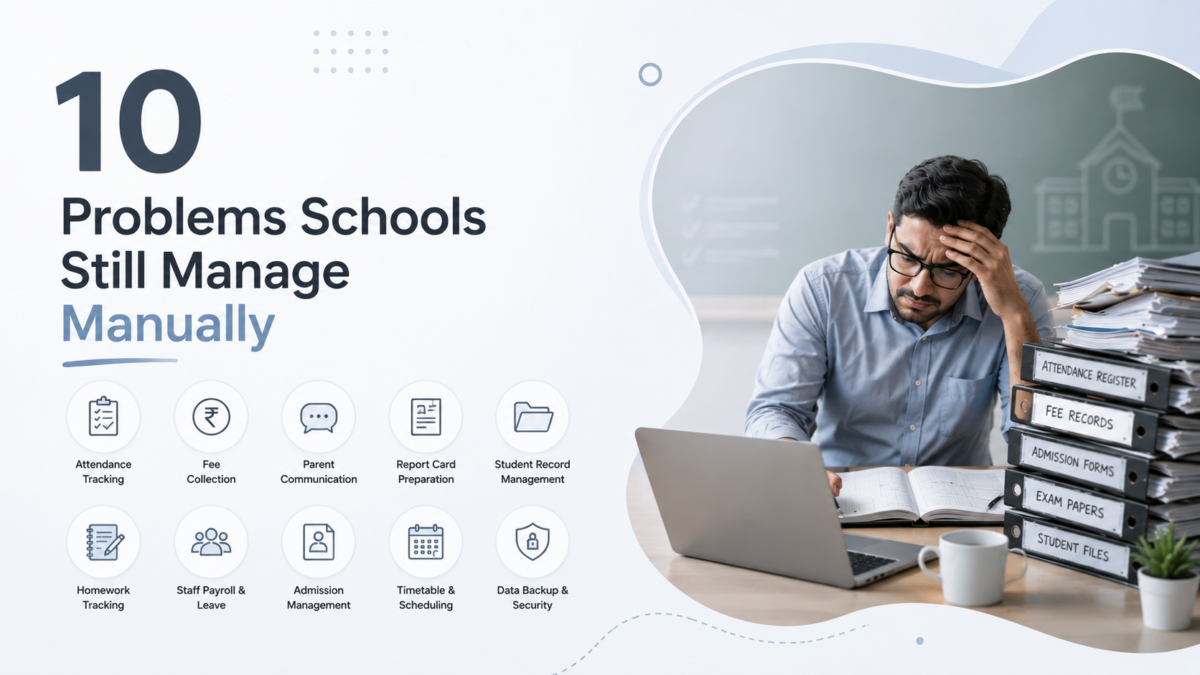
Even today, many schools continue to depend on registers, spreadsheets, handwritten receipts, and paper-based communication for day-to-day operations. While these traditional methods may seem manageable initially, they often create operational challenges as the school grows.
Manual systems usually lead to delays, duplication of work, communication gaps, and unnecessary pressure on administrative staff.
Here are ten common problems schools still manage manually — and why they become difficult over time.
1. Attendance Tracking
In many schools, attendance is still recorded in physical registers. Teachers spend valuable classroom time marking attendance manually, and administrative staff later compile the records again for reports.
This process becomes difficult when:
- Student strength increases
- Parents request attendance history
- Monthly reports need to be generated
Manual attendance also increases the chances of errors and missing records.
2. Fee Collection Management
Fee collection is one of the most time-consuming administrative tasks in schools.
Schools often manage:
- Cash payments
- Manual receipts
- Due tracking
- Fine calculation
- Fee reminders
through registers or spreadsheets.
This creates problems such as:
- Missed due payments
- Duplicate entries
- Difficulty tracking pending fees
- Long queues during fee submission
Without automation, fee management can become overwhelming.
3. Parent Communication
Many schools still rely on printed notices, diary notes, or individual phone calls to communicate with parents.
This approach creates several issues:
- Notices may not reach parents
- Communication becomes inconsistent
- Staff spend excessive time making calls
- Emergency communication becomes difficult
Digital communication systems solve this by sending instant notifications through WhatsApp, SMS, or mobile apps.
4. Report Card Preparation
Preparing report cards manually requires teachers to repeatedly calculate totals, percentages, and grades.
This process often leads to:
- Calculation errors
- Delayed results
- Formatting inconsistencies
- Increased workload during exams
Automated systems can generate report cards within minutes.
5. Student Record Management
Schools manage large amounts of student information:
- Admission forms
- Transfer certificates
- Academic records
- Contact details
- Medical information
When stored physically, records become difficult to search and maintain. Missing documents and duplicate files are also common problems.
6. Homework and Assignment Tracking
In manual systems, homework communication depends heavily on diaries and verbal instructions.
Problems arise when:
- Students forget assignments
- Parents remain unaware
- Teachers cannot track submissions properly
Digital platforms allow schools to maintain better visibility and accountability.
7. Staff Payroll and Leave Management
Manual salary calculations and leave tracking require significant administrative effort.
Common challenges include:
- Incorrect salary calculations
- Difficulty managing deductions
- Leave record confusion
- Delayed payroll processing
As staff numbers grow, manual HR management becomes increasingly inefficient.
8. Admission Management
Admission season often creates chaos in schools using manual systems.
Staff usually handle:
- Paper forms
- Manual verification
- Offline fee collection
- Physical document storage
This increases waiting time and creates unnecessary administrative burden.
Online admission systems simplify the entire process.
9. Timetable and Exam Scheduling
Creating timetables manually is a complex task, especially when:
- Multiple teachers are involved
- Classes overlap
- Changes are required frequently
Even small scheduling errors can disrupt school operations.
10. Data Backup and Security
Physical records are vulnerable to:
- Damage
- Misplacement
- Fire
- Water exposure
- Unauthorized access
Manual systems also make it difficult to maintain backups.
Digital systems provide safer and more organized record management.
Final Thoughts
Manual systems may seem familiar, but they often consume more time, create inefficiencies, and increase administrative pressure. As schools grow, these challenges become even more difficult to manage.
Digital school management systems help schools streamline operations, reduce paperwork, improve communication, and create a more organized environment for administrators, teachers, students, and parents.

Leave a Reply