
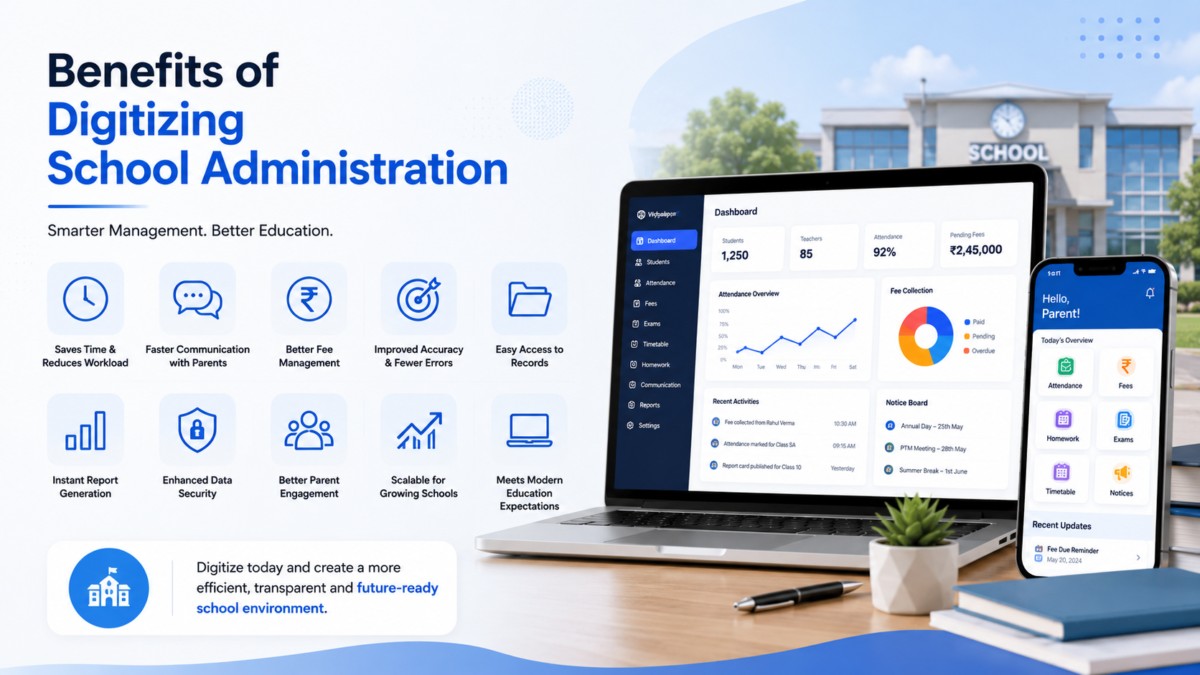
School administration has changed significantly over the past few years. Tasks that once depended entirely on registers, paperwork, and manual communication are now being managed digitally through school ERP systems and automation tools.
From attendance tracking and fee collection to report cards and parent communication, digital systems help schools operate more efficiently while reducing administrative workload.
As schools continue to grow and expectations from parents increase, digitizing school administration is becoming less of an option and more of a necessity.
What Does Digitizing School Administration Mean?
Digitizing school administration simply means replacing manual processes with digital systems and software.
Instead of:
- Maintaining physical registers
- Creating handwritten fee receipts
- Sending printed notices
- Managing files manually
schools can use centralized digital platforms to handle daily operations.
This improves speed, accuracy, communication, and overall management.
Major Benefits of Digitizing School Administration
1. Reduced Administrative Workload
One of the biggest advantages of digitization is the reduction in repetitive tasks.
Activities like:
- Attendance entry
- Fee calculations
- Receipt generation
- Exam report preparation
- Student record management
can all be automated.
This allows administrators and teachers to spend less time on paperwork and more time focusing on students and academics.
2. Faster Communication with Parents
Traditional communication methods often depend on diary notes, printed circulars, or phone calls.
Digital systems allow schools to instantly send:
- Fee reminders
- Attendance alerts
- Homework updates
- Circulars
- Emergency notices
through:
- SMS
- Mobile apps
- Email notifications
This keeps parents informed in real time.
3. Improved Fee Management
Fee collection becomes much easier when managed digitally.
Schools can:
- Accept online payments
- Track pending dues
- Generate automatic receipts
- Send payment reminders
- Maintain fee history
This reduces manual errors and improves financial tracking.
Parents also appreciate the convenience of online payment options.
4. Better Accuracy and Fewer Errors
Manual systems often lead to:
- Duplicate entries
- Calculation mistakes
- Missing records
- Incorrect reports
Digital systems automate calculations and maintain centralized records, reducing the possibility of human error.
This improves overall operational reliability.
5. Quick Access to School Records
Finding old files and records manually can consume a lot of time.
With digitized administration, schools can instantly access:
- Student information
- Attendance history
- Academic records
- Fee reports
- Staff details
within seconds.
This improves efficiency and reduces dependency on physical paperwork.
6. Automatic Report Generation
Generating reports manually can take hours or even days.
Digital systems can instantly generate:
- Attendance reports
- Examination reports
- Financial reports
- Student performance summaries
- Staff reports
This helps school administrators make faster and more informed decisions.
7. Enhanced Data Security
Paper-based records are vulnerable to:
- Damage
- Theft
- Misplacement
- Fire or water exposure
Digitized systems provide:
- Cloud backups
- Secure access control
- Password protection
- Data recovery options
This helps schools protect important information more effectively.
8. Better Parent Engagement
Modern parents expect transparency and regular updates from schools.
Digital systems improve parent engagement by allowing parents to:
- Monitor attendance
- Check homework
- View report cards
- Receive instant notifications
- Track fee payments
through parent portals or mobile apps.
This strengthens communication between schools and families.
9. Scalability for Growing Schools
As schools grow, managing operations manually becomes increasingly difficult.
Digitized systems help schools manage:
- Higher student strength
- Multiple branches
- Larger staff teams
- Increased communication
without significantly increasing administrative workload.
10. Supports Modern Educational Expectations
Today’s schools are expected to provide faster communication, better transparency, and digital convenience.
Features like:
- Online fee payment
- Mobile apps
- Instant notifications
- Digital report cards
- Online admissions
are quickly becoming standard expectations.
Schools that adopt digital systems often appear more organized and future-ready.
Common Areas Schools Digitize First
Most schools usually begin digitization with:
- Attendance management
- Fee management
- Parent communication
- Examination management
- Student information systems
Over time, they expand into:
- Transport management
- Library systems
- HR and payroll
- Online admissions
- Mobile applications
Is Digitization Only for Large Schools?
Not at all.
Small and mid-sized schools can benefit equally from digital administration systems.
In many cases, smaller schools adopt ERP systems early to avoid operational challenges as they grow.
Even basic automation can save significant time and improve overall management.
Final Thoughts
Digitizing school administration is not simply about replacing registers with software. It is about creating a more efficient, transparent, and organized system for managing school operations.
From reducing paperwork and improving communication to simplifying fee collection and generating reports instantly, digital systems help schools operate more smoothly while improving the experience for students, parents, teachers, and administrators.
As education continues to evolve, schools that embrace digital transformation will be better prepared for the future.